Read more of this story at Slashdot.
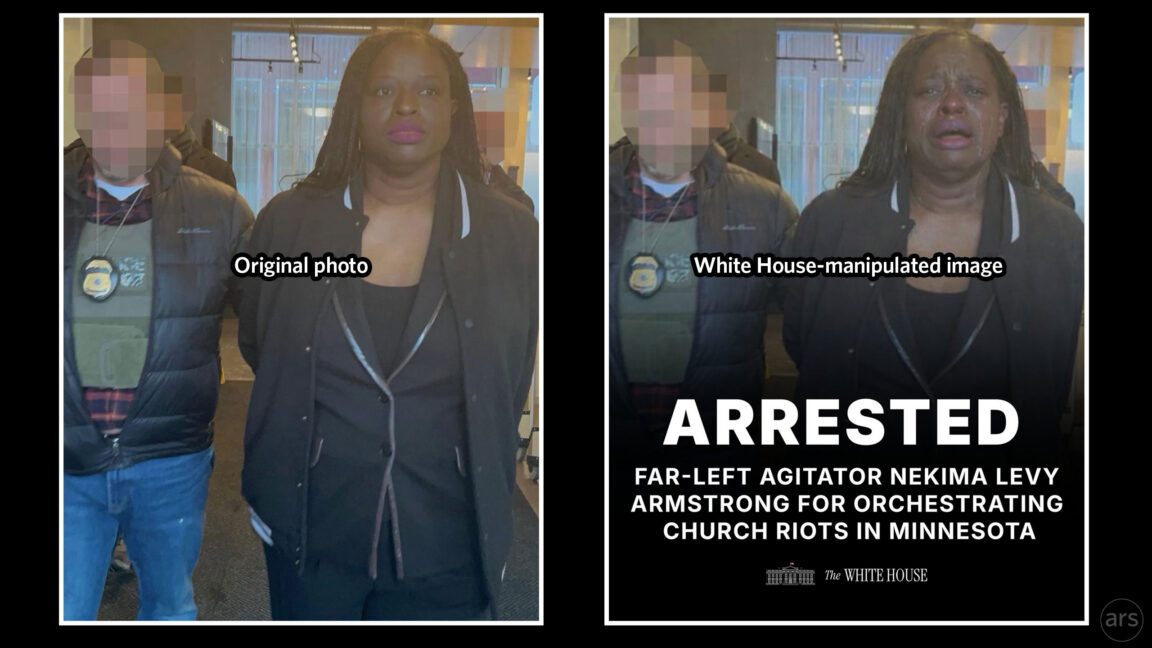
The Trump White House yesterday posted a manipulated photo of Nekima Levy Armstrong, a Minnesota civil rights attorney who was arrested after protesting in a church where a pastor is allegedly also an Immigration and Customs Enforcement (ICE) official.
Secretary of Homeland Security Kristi Noem posted what seems to be the original photo of Armstrong being led away by an officer yesterday morning. A half hour later, the official White House X account posted an altered version in which Armstrong's face was manipulated to make it appear that she was crying.
"The White House shared an AI-edited photo of Nekima, depicting her in tears and scared when, in actuality, she was poised, determined, and unafraid," NAACP President and CEO Derrick Johnson said yesterday.
Reader-added context on X said, "This photo has been digitally altered to make Nekima Levy Armstrong appear to be in distress. The Director of DHS herself posted the unedited photo in an earlier announcement." White House Deputy Communications Director Kaelan Dorr defended the post after criticism of the image manipulation.
"Enforcement of the law will continue. The memes will continue. Thank you for your attention to this matter," Dorr wrote. The White House post with the manipulated image called Levy Armstrong a "far-left agitator" who "orchestrated[ed] church riots in Minnesota."
A DHS press release about the arrest used the same image posted by Noem, without the alteration.
Jordan Kushner, an attorney for Levy Armstrong, said, “It is just so outrageous that the White House would make up stories about someone to try and discredit them. She was completely calm and composed and rational. There was no one crying. So this is just outrageous defamation.”
Speaking to The Associated Press, Kushner also said that the "video Levy Armstrong’s husband shot 'dismantles what they claim' and that the video would be released soon."
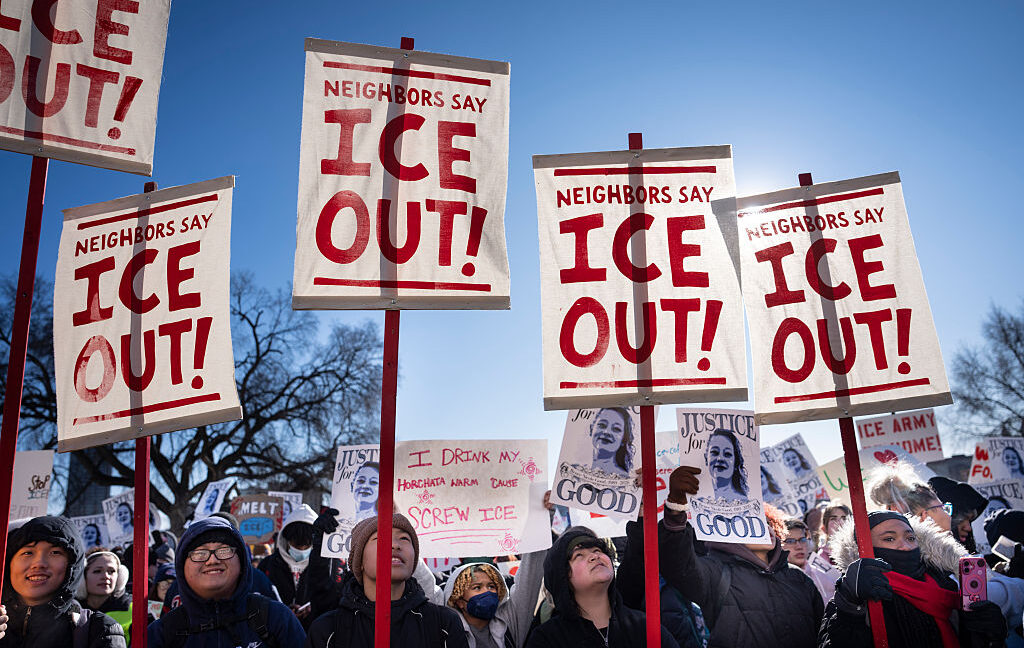
Protesters disrupted services on Sunday at the Cities Church in St. Paul, chanting "ICE OUT" and "Justice for Renee Good." The St. Paul Pioneer Press quoted Levy Armstrong as saying, “When you think about the federal government unleashing barbaric ICE agents upon our community and all the harm that they have caused, to have someone serving as a pastor who oversees these ICE agents is almost unfathomable to me."
The church website lists David Easterwood as one of its pastors. Protesters said this is the same David Easterwood who is listed as a defendant in a lawsuit that Minnesota Attorney General Keith Ellison filed against Noem and other federal officials. The lawsuit lists Easterwood as a defendant "in his official capacity as Acting Director, Saint Paul Field Office, U.S. Immigration and Customs Enforcement."
Levy Armstrong, who is also a former president of the NAACP's Minneapolis branch, was arrested yesterday morning. Announcing the arrest, Attorney General Pam Bondi wrote, "WE DO NOT TOLERATE ATTACKS ON PLACES OF WORSHIP." Bondi alleged that Levy Armstrong "played a key role in organizing the coordinated attack on Cities Church in St. Paul, Minnesota."
Noem said Levy Armstrong "is being charged with a federal crime under 18 USC 241," which prohibits "conspir[ing] to injure, oppress, threaten, or intimidate any person in any State, Territory, Commonwealth, Possession, or District in the free exercise or enjoyment of any right or privilege secured to him by the Constitution or laws of the United States."
"Religious freedom is the bedrock of the United States—there is no first amendment right to obstruct someone from practicing their religion," Noem wrote.
St. Paul School Board member Chauntyll Allen was also arrested. Attorneys for the Cities Church issued statements supporting the arrests and saying they "are exploring all legal options to protect the church and prevent further invasions."
A federal magistrate judge initially ruled that Levy Armstrong and Allen could be released, but they were still being held last night after the government "made a motion to stay the release for further review, claiming they might be flight risks," the Pioneer Press wrote.
Kushner called the arrests a "farce" and alleged that Bondi and Noem ordered the arrests only so they could celebrate them on social media, according to the Pioneer Press. “This doesn’t happen in a legitimate prosecution,” Kushner said. “These are officials making a political decision, and purposely making a political spectacle and a political circus out of the court system for their own purposes.”
Kushner also "said federal agents detained one of Armstrong’s friends two days [previously], using force to tackle her in a hotel lobby, under the mistaken impression she was Armstrong," the Pioneer Press wrote.
Marques Armstrong, Levy Armstrong’s husband, said she offered to turn herself in after the mistaken detention of her friend.
“Initially they agreed and then a call came from up high and said, ‘No, we have to take her there (at the hotel).’ They wanted her in handcuffs," he was quoted as saying. An “agent took photos and said it won’t go on social media. I knew it was a lie,” he also said.
The White House's posting of a manipulated version of the arrest photo could be used in Levy Armstrong's legal defense. As the New York Times wrote, her lawyer could argue that the post was an improper extrajudicial statement that may prejudice potential jurors and that it shows the Justice Department filed charges vindictively. We contacted Kushner about the manipulated photo and case today and will update this article if he provides any comment.
The NAACP called for the release of Levy Armstrong, Allen, and a third arrestee, William Kelly. "Their arrests violated their constitutional rights and NAACP demands their immediate release," the NAACP said. "Ms. Armstrong and her fellow demonstrators gathered peacefully at a church over the pastor's alleged leadership within the U.S. Immigration and Customs Enforcement (ICE). The protests follow the increase in ICE activity and the fatal shooting of Minneapolis resident Renee Nicole Good."
The Justice Department also tried to bring charges against journalist Don Lemon, but a judge rejected the charges. Lemon was at the demonstration but said he was there as a journalist and not a protester.
The Department of Homeland Security (DHS) has backed down from a fight to unmask the owners of Instagram and Facebook accounts monitoring Immigration and Customs Enforcement (ICE) activity in Pennsylvania.
One of the anonymous account holders, John Doe, sued to block ICE from identifying him and other critics online through summonses to Meta that he claimed infringed on core First Amendment-protected activity.
DHS initially fought Doe's motion to quash the summonses, arguing that the community watch groups endangered ICE agents by posting "pictures and videos of agents’ faces, license plates, and weapons, among other things." This was akin to "threatening ICE agents to impede the performance of their duties," DHS alleged. DHS's arguments echoed DHS Secretary Kristi Noem, who has claimed that identifying ICE agents is a crime, even though Wired noted that ICE employees often post easily discoverable LinkedIn profiles.
To Doe, the agency seemed intent on testing the waters to see if it could seize authority to unmask all critics online by invoking a customs statute that allows agents to subpoena information on goods entering or leaving the US.
But then, on January 16, DHS abruptly reversed course, withdrawing its summonses from Meta.
A court filing confirmed that DHS dropped its requests for subscriber information last week, after initially demanding Doe's “postal code, country, all email address(es) on file, date of account creation, registered telephone numbers, IP address at account signup, and logs showing IP address and date stamps for account accesses."
The filing does not explain why DHS decided to withdraw its requests.
However, previously, DHS requested similar information from Meta about six Instagram community watch groups that shared information about ICE activity in Los Angeles and other locations. DHS withdrew those requests, too, after account holders defended their First Amendment rights and filed motions to quash their summonses, Doe’s court filing said.
To defeat DHS' summonses, Doe shared all his group's online posts with the court. An attorney representing Doe at the American Civil Liberties Union of Pennsylvania, Ariel Shapell, told Ars that Doe's groups posted "pretty innocuous" content, like “information and resources about immigrant rights, due process rights, fundraising, and vigils.”
It's possible DHS caved due to lack of evidence supporting claims that Doe's groups' posts carried implicit threats to “assault, kidnap, or murder any federal official,” as DHS had argued. But it's also possible that DHS keeps trying and failing to unmask ICE critics due to strong First Amendment protections working to preserve the right to post anonymously online.
The attempt to unmask Doe's accounts came as criticism of ICE is mounting nationwide, and a win could have given ICE broad authority to attack that growing base of critics if DHS had dug in and its defense actually held.
DHS's withdrawal of the summonses could signal that the argument the agency tried to raise—weirdly using a statute tied to the “importation/exportation of merchandise" to seize "unlimited subpoena authority" of ICE critics online—is clearly not a winning one.
Meta did not immediately respond to Ars' request for comment. But Meta did play a role in challenging DHS' summonses, initially by seeking more information from the agency and then notifying account holders to provide an opportunity to quash the summonses before information was shared.
So far, the playbook for community watch groups on Facebook and Instagram has been to follow Meta's advice in order to block identifying information from being shared. But it remains unclear if Meta may have complied with DHS's requests if account holders were not able to legally fight to quash them, perhaps leaving a vulnerable gray area for community watch groups.
For Doe and any others involved in "MontCo Community Watch," DHS's withdrawal of the summonses likely comes as a relief. But this wasn't the first time DHS tried and failed to unmask online critics, so it's just as likely that fears remain that DHS will continue trying to identify groups that are posting footage to raise awareness of ICE's most controversial moves.
ICE critics have used footage of tragic events—like Renee Good’s killing and eight other ICE shootings since September—to support calls to remove ICE from embattled communities and abolish ICE.
Tensions remain high as US citizens defend both their neighbors and their own constitutional rights. Most recently, shocking footage of ICE using a 5-year-old boy as bait to trap other family members intensified calls to defund ICE. Public backlash also raged after videos showed ICE removing a US citizen from his home in his underwear. That arrest happened while ICE was conducting a warrantless search that a whistleblower warned is becoming the new ICE norm after an internal memo said that agents can enter homes without a judicial warrant.
Some politicians are starting to take up the call to diminish ICE's power. On Thursday, the majority of House Democrats voted to defund ICE, which Politico noted was a "remarkable shift from when dozens of them voted to expand the Trump administration’s immigration enforcement authority just one year ago." Of course, the ICE budget bill passed anyway, since Republicans control the House, but with public approval of ICE tanking, any ongoing pushback could hurt Republicans in midterms and eventually even doom ICE if momentum is sustained.
As of today, the US is no longer a member of the World Health Organization—and it leaves the United Nations health agency with hundreds of millions of dollars in unpaid bills, according to reporting by Stat News.
A year ago today, the US informed the WHO of its intent to exit, setting the clock for a one-year withdrawal period mandated in a 1948 joint resolution of Congress. But, in practice, the withdrawal was immediate, with the Trump administration cutting all ties with WHO upon the announcement. In explaining his reasoning for leaving the WHO, Trump referenced his long-standing complaints about the agency’s handling of the COVID-19 pandemic, dues payments, and alleged protection of China. Trump had attempted extract the US from WHO during his first term, but the Biden administration rescinded the withdrawal on the first day in office, well before the one-year notice period was reached.
The joint resolution also stipulated that the US would have to pay its financial obligations in full before departing. But, that too has not been honored by the Trump administration. According to Stat, the US owed the WHO $278 million in dues, which are a percentage of each member state’s gross domestic product. That dues payment covered the country's 2024–2025 membership, as WHO runs on a two-year budget cycle.
In the past, such payments were made through the State Department’s international agencies bureau. A spokesperson for the department told Stat that there was no way the US would pay its debt.
“The United States will not be making any payments to the WHO before our withdrawal on January 22, 2026," the spokesperson said in an emailed statement. "The cost [borne] by the US taxpayer and US economy after the WHO’s failure during the COVID pandemic—and since—has been too high as it is. We will ensure that no more US funds are routed to this organization."
In addition, the US had also promised to provide $490 million in voluntary contributions for those two years. The funding would have gone toward efforts such as the WHO's health emergency program, tuberculosis control, and the polio eradication effort, Stat reports. Two anonymous sources told Stat that some of that money was paid, but they couldn't provide an estimate of how much.
The loss of both past and future financial support from the US has been a hefty blow to the WHO. Immediately upon notification last January, the WHO began cutting costs. Those included freezing recruitment, restricting travel expenditures, making all meetings virtual, limiting IT equipment updates, and suspending office refurbishment. The agency also began cutting staff and leaving positions unfilled. According to Stat, the WHO staff is on track to be down 22 percent by the middle of this year.
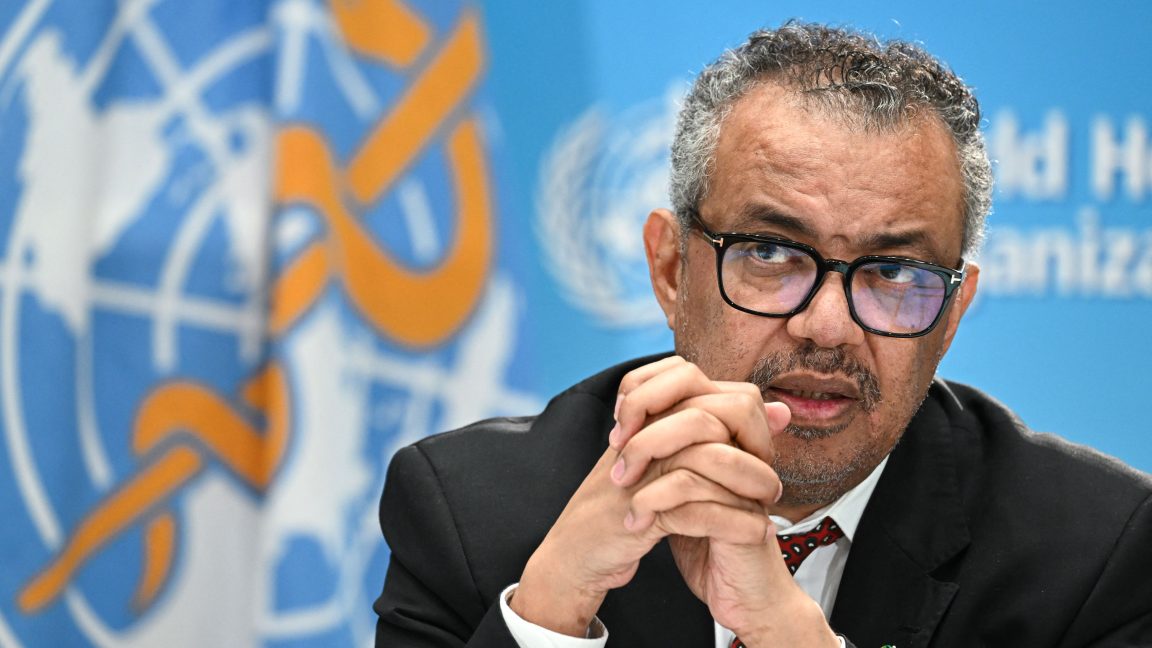
In a recent press conference, WHO Director-General Tedros Adhanom Ghebreyesus said the US withdrawal is a "lose-lose situation" for the US and the rest of the world. The US will lose access to infectious disease intelligence and sway over outbreak responses, and global health security will be weakened overall. "I hope they will reconsider," Tedros said.
A federal judge today ordered the US government to stop searching devices seized from the house of a Washington Post reporter. It may be only a temporary reprieve for the Post and reporter Hannah Natanson, however. Further proceedings will be held on whether the search can resume or whether the government must return the devices.
Natanson herself isn't the subject of investigation, but the FBI executed a search warrant at her home and seized her work and personal devices last week as part of an investigation into alleged leaks by a Pentagon contractor. The Post filed a motion to force the return of the reporter's property, and a separate motion for a standstill order that would prevent review of the seized devices until the court rules on whether they must be returned.
"Almost none of the seized data is even potentially responsive to the warrant, which seeks only records received from or relating to a single government contractor," a Post court filing today said. "The seized data is core First Amendment-protected material, and some is protected by the attorney-client privilege."
The materials "should be returned because the search and seizure of Natanson’s reporting materials was an unconstitutional prior restraint—government action that blocks expressive activity before it can occur," the filing said, adding that the "government’s legitimate interests can be satisfied by issuing a subpoena to Natanson and/or The Post for the same items sought by the warrant." The multi-device seizure has "suppressed The Post and Natanson’s ability to publish stories on completely unrelated topics," the filing said.
US Magistrate Judge William Porter today granted the motion for a standstill order. "The government must preserve but must not review any of the materials that law enforcement seized pursuant to search warrants the Court issued... until the Court authorizes review of the materials by further order," the ruling said.
The Post asked for an expedited briefing and hearing schedule. Porter ordered the government to file a reply by January 28 and scheduled oral arguments for February 6.
FBI agents reportedly seized Natanson's phone, a 1TB portable hard drive, a device for recording interviews, a Garmin watch, a personal laptop, and a laptop issued by The Washington Post. Natanson has said she's built up a contact list of 1,100 current and former government employees and communicates with them in encrypted Signal chats.
"The day the FBI raided Natanson’s residence, undersigned counsel reached out to the government to advise that the seized items contain materials protected by the First Amendment and the attorney-client privileges," attorneys for The Washington Post and Natanson told the court. "Undersigned counsel asked the government to refrain from reviewing the documents pending judicial resolution of the dispute, but the government refused."
The filing said that unless a standstill order is issued, "the government will commence an unrestrained search of a journalist’s work product that violates the First Amendment and the attorney-client privilege, ignores federal statutory safeguards for journalists, and threatens the trust and confidentiality of sources."
The six devices seized from Natanson "contain essentially her entire professional universe: more than 30,000 Post emails from the last year alone, confidential information from and about sources (including her sources and her colleagues’ sources), recordings of interviews, notes on story concepts and ideas, drafts of potential stories, communications with colleagues about sources and stories, and The Post’s content management system that houses all articles in progress," the Post said. "The devices also housed Natanson’s encrypted Signal messaging platform that she used to communicate with her more than 1,100 sources. Without her devices, she 'literally cannot contact' these sources."
The devices also contain personal records like medical information, financial information, and details on wedding planning, the Post said. "The government seized this proverbial haystack in an attempt to locate a needle," the Post said.
The case involves Aurelio Perez-Lugones, a system administrator with a top-secret security clearance, who was accused of taking classified intelligence reports home.
"Even the government cannot expect to find many records responsive to the warrant in this ocean of data because its criminal complaint alleges that Perez-Lugones possessed only a small number of documents potentially containing classified or secret information, which he only began collecting three months ago," the Post said. "Meanwhile, Natanson has thousands of communications across her more than 1,100 sources. And her devices contain years of data about past and current confidential sources and other unpublished materials. At best, the government has a legitimate interest in only an infinitesimal fraction of the data it has seized."
The Post suggested that instead of poring through all of Natanson's devices, the government could get a subpoena "for the same items sought by the warrant—communications with Perez-Lugones, or records allegedly received from him."
The Freedom of the Press Foundation today said the judge was right to temporarily block the review of materials and should block the review permanently after the scheduled hearing.
“The search and seizure of Washington Post reporter Hannah Natanson’s records is unconstitutional and illegal in its entirety," said Seth Stern, the group's chief of advocacy. "But even the Trump administration’s policies require searches of journalists’ materials to be narrow and targeted and that authorities use filter teams and other measures to avoid searching protected records. That the administration wouldn’t follow its own guidelines shows that the raid on Natanson’s home wasn’t about any criminal investigation, and certainly wasn’t about national security. It was a fishing expedition intended to intimidate and retaliate against a journalist who had managed to cultivate sources all over the government."
Read more of this story at Slashdot.